What is a concentration gradient?
A concentration gradient is the difference in the concentration of a substance (solute) between two regions, particularly across a cell membrane. This difference causes the substance to have a net movement from the area of higher concentration to the area of lower concentration, a process known as diffusion, until equilibrium is reached.
What is a cell membrane?
A cell membrane (also called the plasma membrane) is a flexible, protective boundary that surrounds every cell, separating its internal components from the outside environment. Its main job is to control which substances, like nutrients and waste, are allowed to enter or leave the cell, maintaining a stable internal condition.
What is the structure of a cell membrane?
The lipid bilayer is the fundamental structure of the cell membrane, consisting of two layers of phospholipid molecules. The head is composed of a phosphate group attached to a glycerol molecule and often a small, charged or polar molecule.
What are some substances that cells need to move inside their membrane?
Some important substances needed inside a cell are oxygen gas, sodium ions, potassium ions, and glucose. Cells must move carbon dioxide gas from the inside of a cell to the outside.
What is simple diffusion?
Simple diffusion is the passive movement of molecules across a membrane. Diffusion is driven entirely by the concentration gradient, where substances move from an area of high concentration to an area of low concentration until equilibrium is reached.
What is facilitated diffusion?
Facilitated diffusion is a passive transport mechanism that allows essential ions like sodium and potassium to cross the cell membrane. Unlike simple diffusion, this process requires the help of transport proteins (like channel proteins) because the particles are too large or too polar to cross the hydrophobic lipid bilayer on their own.
What are ligands?
A ligand is any molecule (often a signaling molecule like a hormone, neurotransmitter, or drug) that binds specifically and reversibly to another larger molecule, typically a receptor protein. This binding causes a specific functional change in the receptor, initiating a cellular response or opening a membrane channel (as in a ligand-gated channel).
What is membrane potential?
A cell membrane potential is the difference in electrical charge (voltage) that exists across the cell membrane, caused by an unequal distribution of positive and negative ions. This electrical difference is essential for many cell functions, especially in nerve and muscle cells where changes in potential are used to transmit signals.
What is active transport?
Active transport is a critical process by which cells move substances against their concentration gradient (from low to high concentration). Unlike passive diffusion, this "uphill" movement requires the cell to actively expend energy, typically in the form of ATP.
What are cotransporters?
A cotransporter is a protein embedded in the cell membrane that moves two different molecules or ions across the membrane at the same time. It uses the movement of one molecule going down its concentration gradient (like a waterslide) to provide the energy needed to push a second molecule up its concentration gradient (against its flow).
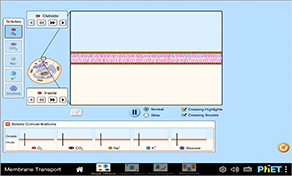 Cells need to let some substances inside and keep others from entering the cell. The membrane of the cell is responsible for this task. Your challenge is to investigate the different ways that cell membranes accomplish this important function.